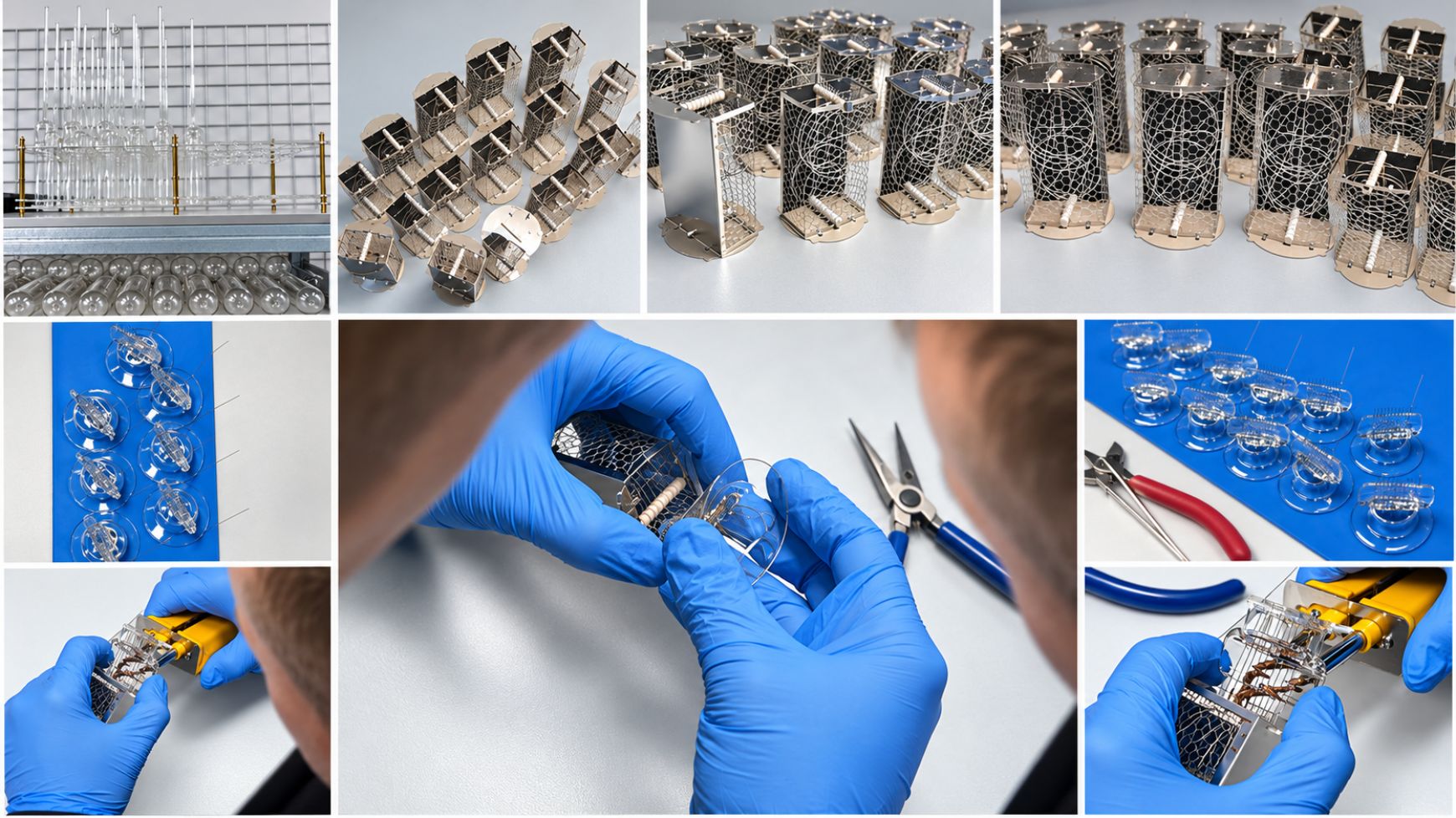
Yes, Nixie tubes are still being made. At Millclock, we manufacture ZIN18 and ZIN70 tubes in Ukraine, starting with individual glass and metal components.
People sometimes assume that every Nixie clock uses tubes found in an old warehouse. It’s an understandable impression. Much of the appeal of these displays comes from their history, and vintage tubes remain an important part of the Nixie world.
But the technology also has a present. On our workbench, you’ll find rows of newly assembled digits, glass envelopes waiting for the next stage, and someone carefully connecting wires by hand.
Here’s a closer look at what goes into them.
New nixie tubes and old stock nixie: what’s the difference?
When shopping for Nixie tubes, you may come across the term NOS, or “new old stock.” It usually describes tubes manufactured years ago that have remained unused.
A vintage tube can be unused without being recently made. Newly manufactured tubes, such as our ZIN18 and ZIN70, are produced today.
Both have their place. Some collectors want a particular vintage model for its shape, history or distinctive digits. Others prefer a current-production tube and the ability to speak directly with its manufacturer.
Neither age nor a production date tells you everything about quality. Assembly, testing and the way a tube is operated all matter.
It begins with the numbers
Look closely at a Nixie tube when it’s switched off. The numbers are still there.
Each digit is a separate metal cathode, shaped like a number and positioned within a layered assembly. When the tube operates, a glow discharge illuminates the selected cathode.
Before that can happen, those delicate parts need to be assembled and held in position. In the photographs, you can see the digit shapes behind the fine metal mesh, along with supports, spacers and connecting wires.
There is a surprising amount of structure inside something you might normally glance at just to check the time.

Small connections, careful hands
The glass base contains metal leads that provide electrical connections through the glass. These must be connected to the internal assembly.
This is one of the stages where the scale of the work becomes clear. A technician holds the parts in gloved hands, aligns them and works on individual connections.
From a distance, a batch of assemblies looks almost identical. Up close, you begin to notice how many small parts must come together in each one.

The glass has a job to do
The glass envelope gives a Nixie tube its familiar appearance, but it also forms the sealed environment needed for the discharge.
Our production photographs show empty envelopes with long glass stems. Those stems serve a purpose during processing; they are not part of the finished tube’s everyday appearance.
After the internal assembly is enclosed, the tube goes through evacuation, gas filling and sealing. The gas, electrodes and electrical conditions work together to produce the glow.
The finished object looks simple from the outside. Getting it to that point takes several separate operations.


Why production takes time
A tube can look complete before its behaviour has been checked.
Testing means looking beyond whether it lights up at all. The digits need to be examined individually, including how fully and consistently they illuminate.
Glasswork, assembly, connections and testing each require attention. Making a batch involves repeating that care across many individual tubes.
That is why we like showing the workbench. It makes the process easier to understand than a photograph of a finished clock alone.
From our workshop to your clock
Manufacturing our own tubes lets us build clocks around designs we know from the inside. It also gives customers a direct point of contact for questions about tubes, replacement availability and support.
If you’d like to see where these parts end up, explore our ZIN18 clocks, ZIN70 clocks, or individual Nixie tubes.
And the next time you watch a digit change, take a closer look through the glass. You’ll be able to recognise some of the parts that were sitting on the workbench.


