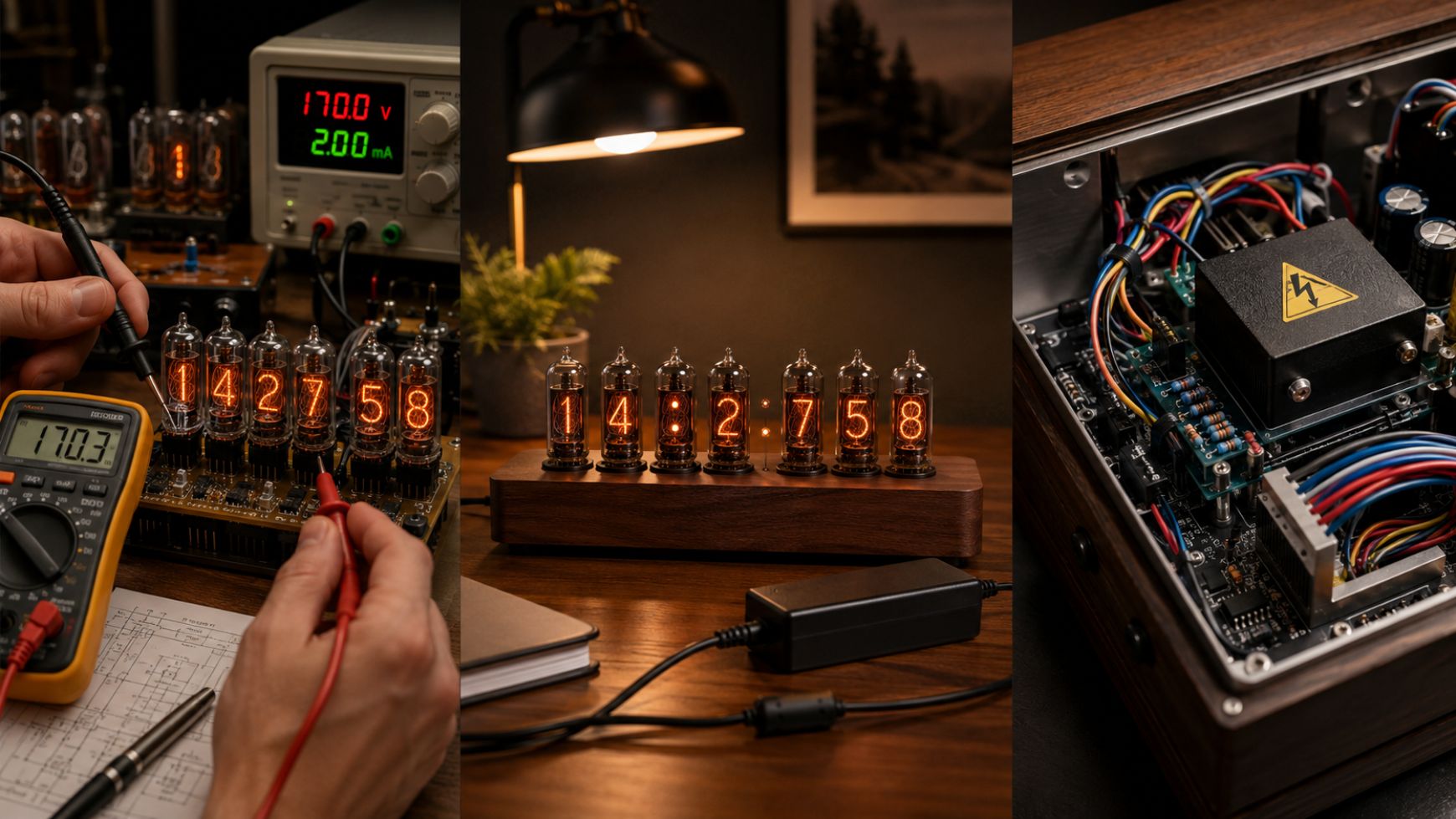
Nixie clocks often create the same first reaction: they look beautiful but also a little mysterious. Glass tubes, orange glowing digits, vintage electronics, and the word “voltage” can make people wonder whether a Nixie clock is actually safe to use at home.
The simple answer is yes: a properly designed, finished Nixie clock is safe for everyday use. But it is also important to understand what is happening inside the clock and how to use it correctly.
A Nixie clock is not the same as a regular LED desk clock. It uses real glass tubes, and those tubes need higher voltage to glow. That does not mean the clock is dangerous when used normally. It means the electronics inside must be designed and enclosed properly.
Why do Nixie tubes need high voltage?
A real Nixie tube works in a different way from an LED display. Inside the glass tube, each digit is a separate metal cathode. When the clock selects a number, that digit glows with a warm orange light.
To make this happen, the clock needs a high-voltage circuit inside. This is part of what gives real Nixie tubes their unique look. The glow is not a screen effect, nor is it an LED imitation. It is a real gas-discharge display.
If you want to understand the difference between real tubes and modern imitations, you can read our guide: Real Nixie Tube Clock vs LED Nixie Clock.
Is the high voltage exposed?
In a finished Nixie clock, the high-voltage parts should not be exposed to the user. They are placed inside the clock body and are not meant to be touched.
This is the main difference between a finished clock and a DIY electronics project. In a DIY build, the user may work directly with circuit boards, wiring, and high-voltage sections. A finished handmade Nixie clock is built as a complete product for normal use.
For example, Millclock Nixie clocks are designed to be ready-to-use. You plug in the power adapter, set the clock, and use it like any other premium desk object. You do not need to touch the electronics inside.
You can explore finished models here: Millclock handmade Nixie clocks.
What about the power supply?
Most modern Nixie clocks do not connect the tubes directly to wall voltage. Instead, they use an external power adapter. The adapter supplies low-voltage power to the clock, and the clock’s internal electronics generate the voltage needed for the tubes.
This is a practical solution for daily use. It keeps the wall power outside the clock and allows the clock to be powered by a compact adapter.
Still, the quality of the power supply matters. Always use the adapter provided with the clock or a replacement recommended by the manufacturer. A random adapter with the wrong voltage, polarity, or current rating can cause problems.
Can you touch Nixie tubes?
You can touch the glass tubes carefully when the clock is off and cool, but there is no reason to do so in normal daily use. Nixie tubes are made of glass, so the bigger everyday risk is not electricity—it is breaking the tube.
Avoid pressing on the tubes, pulling them, or trying to remove them unless the manufacturer gives clear instructions. If a tube is damaged, cracked, loose, or behaves strangely, stop using the clock and contact support.
For compact modern models, you can see the ZIN18 Nixie clocks. For larger statement clocks, the ZIN70 Nixie clocks are worth exploring.
Are Nixie clocks safe around children and pets?
A Nixie clock is safe as a display object when placed correctly, but it is not a toy.
Because the clock has glass tubes, it should be placed somewhere stable: a desk, shelf, cabinet, or office table. It should not sit on the edge of furniture where it can easily be pulled down.
If you have small children or pets, keep the cable managed and place the clock where it cannot be knocked over. This is the same common-sense rule you would use for a table lamp, glass object, or any premium electronic device.
Can a Nixie clock run all day?
Yes, a well-made Nixie clock can be used daily. Many owners leave their clocks on for long periods because the glow is part of the atmosphere.
That said, quality clocks usually include features that help with long-term use. Brightness control, night mode, and digit cycling routines can make the clock more comfortable and help the tubes age more evenly.
This is one reason to choose a finished clock from a specialist manufacturer rather than a very cheap clock with unknown electronics.
Basic safety tips for daily use
Use the clock indoors, in a dry place. Keep it away from water, steam, bathrooms, and outdoor humidity. Do not cover the clock with fabric or place it in a spot where heat cannot escape. Do not use it if the adapter, cable, or case is damaged.
And most importantly, do not open the clock while it is plugged in. The internal electronics are not intended for casual handling.
So, are Nixie clocks safe?
A properly designed Nixie clock is safe for everyday use as a finished product. The high voltage needed for the tubes stays inside the clock, while the user interacts only with the external power adapter, controls, and display.
The key is to buy from a manufacturer that understands real Nixie technology, electronics, and long-term reliability.
If you are looking for a real Nixie clock built for daily use, start with the Millclock Nixie clock collection. A good Nixie clock should not feel risky. It should feel like what it is: a small piece of glowing engineering, made to be enjoyed every day.


