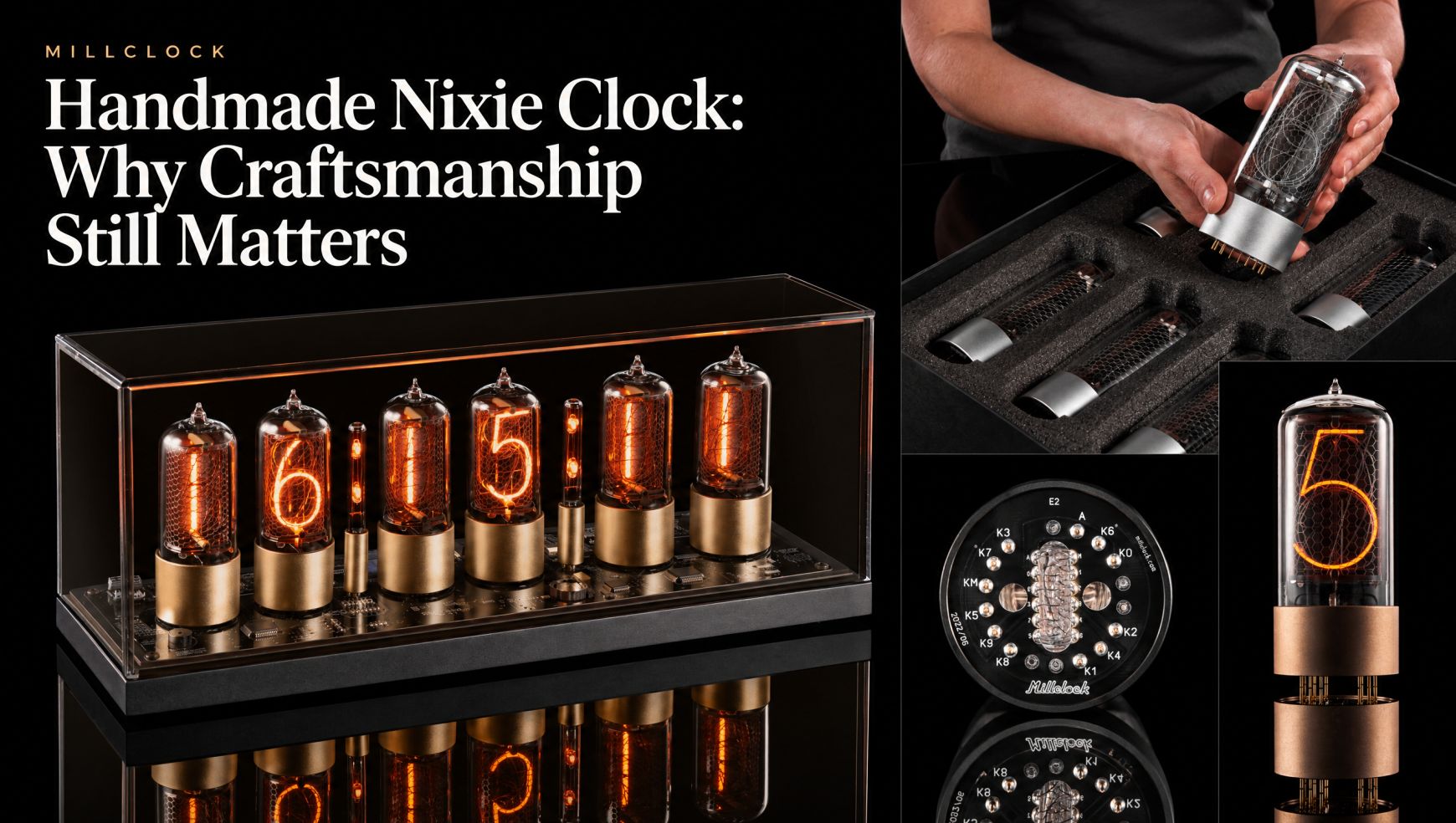
A Nixie clock can be built in many ways.
At the simplest level, you need a set of tubes, a circuit board, a power supply and a case to hold everything together. Technically, that is enough to make a clock.
But it is not enough to make a clock you want to keep on your desk for years.
That is where craftsmanship starts to matter.
A handmade Nixie clock is not about making something old-fashioned by hand just for the sake of it. It is about paying attention to the parts people actually notice every day: the way the tubes sit, how the materials feel, how the case is finished, how the light reflects through the glass and whether the whole object feels balanced.
The tubes are only the beginning
The tubes usually get all the attention, and that makes sense. They are the most unusual part of the clock.
But a good Nixie clock exceeds six glowing tubes mounted on a PCB.
The proportions between the tubes and the case matter. So does the distance between each digit. The sockets should sit straight. The glass should not look like an afterthought. Even a small difference in alignment becomes obvious when six tubes are standing next to each other.
This is why the final assembly still matters, even when the electronics have already been designed correctly.
You can see that approach in our ZIN18 Nixie clocks and larger ZIN70 Nixie clocks.
Materials change the whole impression
A photograph can make almost any product look appealing for a few seconds. The real test comes when you put it on your desk and see it every day.
Anodized aluminum has a different feel from painted plastic. Real wood develops its own character. A glass cover adds weight and depth while protecting the tubes.
These details are not there simply to make a specification list longer. They affect how the clock looks in a room and how it feels to use.
A premium Nixie clock should still look good when it is switched off.
That is something we think about when building Millclock Nixie clocks. The orange glow is important, but the object around it matters just as much.
Small details are surprisingly visible
Nixie tubes are very unforgiving when it comes to poor alignment.
If one tube is slightly higher than the others, you notice it. If the spacing is inconsistent, you notice that too. The same is true for buttons, knobs, case edges and the position of the PCB inside the enclosure.
None of these things sounds dramatic on its own.
Together, they are the difference between something that feels assembled and something that feels finished.
This is also why handmade production makes sense for relatively small batches. There is still an opportunity to inspect each clock individually instead of assuming every part came together perfectly.
Testing is part of craftsmanship too
A finished clock should not leave the workshop simply because it turns on.
The tubes need to be checked. The digits need to light correctly. Brightness control, timekeeping and other functions need to behave as expected.
Modern Nixie clocks also have much more electronics behind them than their vintage appearance suggests. Depending on the model, that can include Wi-Fi time synchronization, automatic brightness adjustment, night mode and anti-poisoning routines.
If you want to understand why those features matter, our guide on how long Nixie tubes last goes into more detail.
Handmade does not mean technologically old
This is probably the most interesting thing about modern Nixie clocks.
The display technology feels like it belongs to another era, but the clock itself does not have to.
You can have real gas-discharge tubes and still expect accurate time synchronization, sensible brightness control and electronics designed for daily use.
That combination is what makes a modern handcrafted Nixie clock interesting. It does not try to reproduce a 1960s device exactly. It takes the part worth keeping—the tubes and their light—and builds a modern product around it.
A clock you plan to keep
Most people do not buy a Nixie clock because they need another way to check the time.
They buy one because they want something different on the desk.
That makes build quality more important than it would be for an ordinary digital clock. If you are going to look at an object every day, the materials, proportions and finishing eventually matter just as much as the technical specifications.
If you are currently choosing a clock, our guide to buying a real Nixie clock covers the practical things worth checking before you order.
A handmade Nixie clock should not feel handmade because it is imperfect. It should feel handmade because someone cared enough to notice the things that mass production usually ignores.


