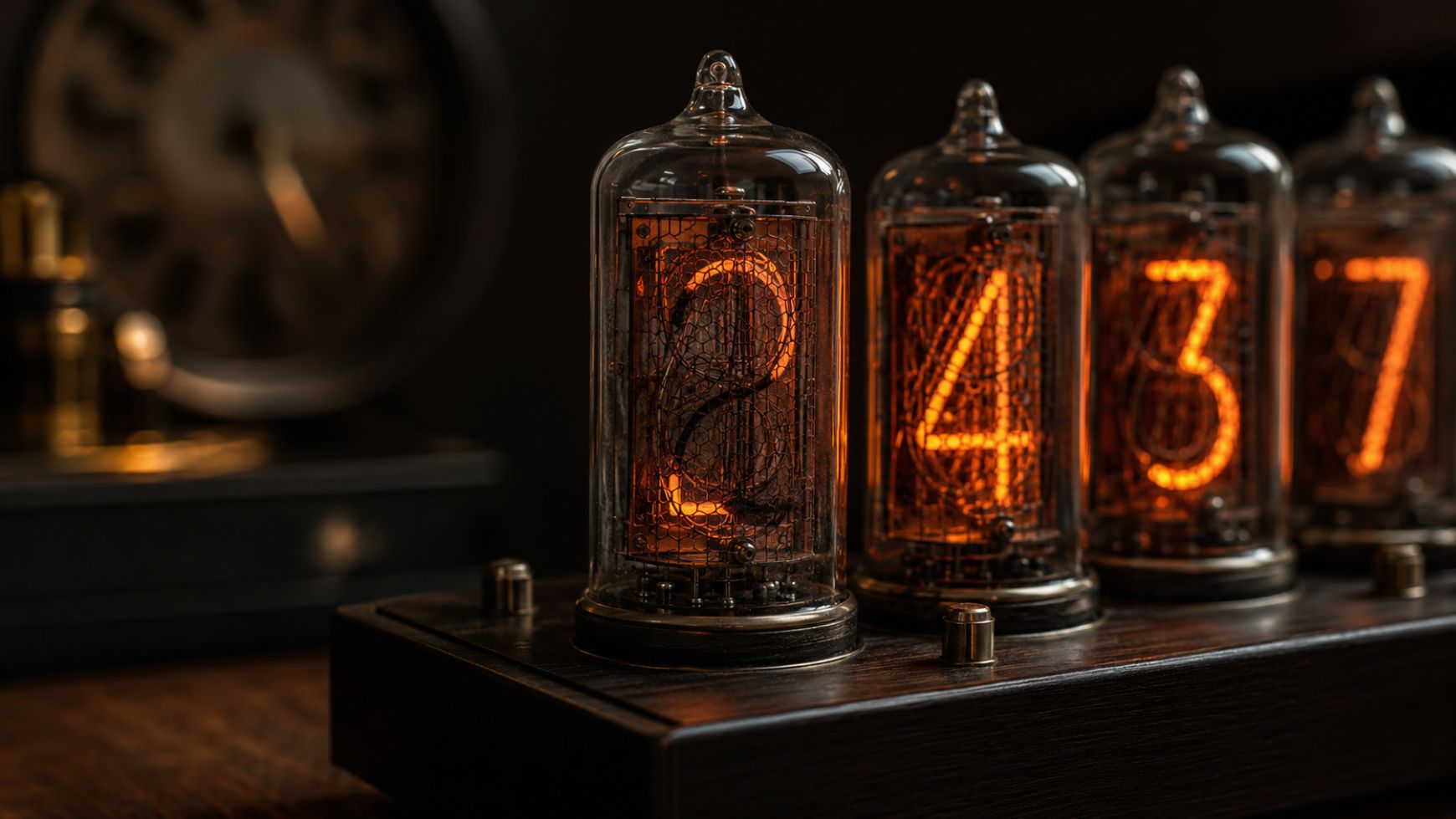
How long do Nixie tubes live? This is one of the first questions people ask when they are considering buying a real Nixie clock.
That is a good question. A Nixie clock is not just a flat-screen digital clock. It uses real glass tubes, gas discharge, metal digits, and carefully controlled electronics. The glow is warm and alive, but many people wonder if that beauty is inherently fragile or short-lived.
The good news is that, with proper use, Nixie tubes can last for many years. Their life expectancy depends on the type of tube, operating current, brightness, electronics, and day-to-day use of the clock.
A real Nixie tube clock is not something to be treated as a disposable gadget. With thoughtful design and proper care, it can become a long-term piece in your home, office, studio, or collection.
What Is the Lifespan of Nixie Tubes?
There is no single number that can describe the lifetime of all Nixie tubes. It depends on a combination of factors.
The first factor is the quality and condition of the tube. Vintage tubes can have completely unique histories. Some were stored unused for decades. Others may have already spent many hours on old clocks, measuring equipment, or industrial devices. Modern Nixie tubes are an alternative because they are not dependent on old stock.
The second factor is how the tube is driven. A Nixie tube requires the correct electrical environment. If the current is too high, the tube may glow brighter, but it may also age faster. With better electronics, the tube can run more smoothly and consistently.
Brightness also matters. Generally speaking, a clock that runs at full brightness all day and all night will put more stress on the tubes than a clock with balanced brightness, dimming, or night mode.
Brightness: More Is Not Always Better
A brighter Nixie tube is not necessarily a better Nixie tube.
Many people adore the deep orange glow, but Nixie clocks do not need to operate at full brightness all the time. In a real room, a lower brightness level often looks more elegant. It gives the clock a warm and calm presence without being too harsh or distracting.
Reducing the brightness can look even better than maximum brightness in a dark office, bedroom, or studio. It also avoids unnecessary wear. This is why brightness control is an important feature of a good Nixie clock.
A clock has to feel satisfying to use on a day-to-day basis, not just look impressive in a photo.
What Is Cathode Poisoning?
One of the most common things people mention when discussing Nixie tube lifespan is cathode poisoning.
Each digit inside a Nixie tube is a separate metal cathode. If some digits are used much more often than others, parts of the tube can age unevenly. Over time, the less-used or unused digits may become less stable or show an uneven glow.
This is one of the reasons why you do not want a clock that simply shows the same number forever with no protection. For example, a Nixie clock in static display mode may keep some digits on for a long time, while others are only occasionally illuminated.
How Do Digit Cycles Work?
Digit cycling, also called anti-poisoning, helps extend the useful life of the tubes.
The idea is simple. Occasionally, the clock briefly runs through all digits in sequence. Every cathode gets a chance to fire up instead of only a few digits working all the time.
In most cases, the owner will hardly notice this process. But for the tubes, it can be useful. It helps the digits work more evenly and supports long-term stability.
This is particularly important for people who use static date, countdown, or custom number modes. If the display does not naturally change frequently, digit cycling becomes more useful.
Can a Nixie clock stay on all day?
You can use a Nixie clock every day, but it does not have to run at full brightness twenty-four hours a day.
Most owners find a simple approach works best: normal brightness during the day, lower brightness in the evening, and night mode during sleeping hours. This keeps the clock looking good and reduces unnecessary tube usage when no one is watching.
Night mode is not only for tube life. It is also about comfort. A real Nixie glow is beautiful, but even a warm glow can feel too strong in a bedroom or dark room if it is not dimmed.
Good daily use is about balance: enough brightness to enjoy the tubes, but not more than necessary.
Proper Use and Maintenance
Nixie tubes do not require a lot of maintenance, but some simple habits will help.
Keep the clock in a dry indoor environment. Keep it away from moisture, heavy dust, and extreme temperatures. Do not place the clock somewhere it could easily be knocked over, especially if it has exposed glass tubes or a glass cover.
Gently wipe the outside with a soft microfiber cloth. Do not use harsh chemicals, especially on glass, aluminum, wood, or coated surfaces. If the clock has a glass cover, wipe it gently and avoid pressing around the tubes.
Only use the power source supplied with or recommended for the clock. A proper power supply is part of reliable operation.
The Importance of Electronics
The tubes are the most visible part of a Nixie clock, but the electronics behind them are equally important.
Good electronics control the current, brightness, timekeeping, display behavior, and protection features. Poor electronics can make the clock appear unstable, create uneven brightness, or put too much strain on the tubes.
So a finished Nixie tube clock should be considered a complete object, not just a set of tubes. Long-term reliability depends on the case, electronics, power supply, firmware, testing, and assembly.
Millclock’s Long-Term Use Approach
At Millclock, we make real Nixie clocks for people who want to enjoy genuine tube glow every day, not just as a short-term novelty.
That means the clock needs to be beautiful to look at, but also reliable in everyday life. Good assembly, testing, careful electronics, and brightness control all play a role. Features such as night mode and digit cycling make the clock more comfortable to use and also help the tubes perform better in the long run.
A Nixie clock should not be something you are afraid to switch on. It should be something you enjoy living with.
Concluding Thoughts
So, how long do Nixie tubes last?
The honest answer is that it depends. Tube type, brightness, electronics, operating current, and daily use all matter. But with careful design and sensible use, Nixie tubes can glow beautifully for many years.
The best way to protect a Nixie tube clock is not to hide it in a box. The best way is to use it correctly. Do not use maximum brightness unless you need to. Use night mode where applicable. Let the digits cycle. Keep your clock clean. Choose quality electronics.
A real Nixie clock is meant to be seen. Its life is in its glow.
And if you treat it well, you can keep that glow for a long time.


