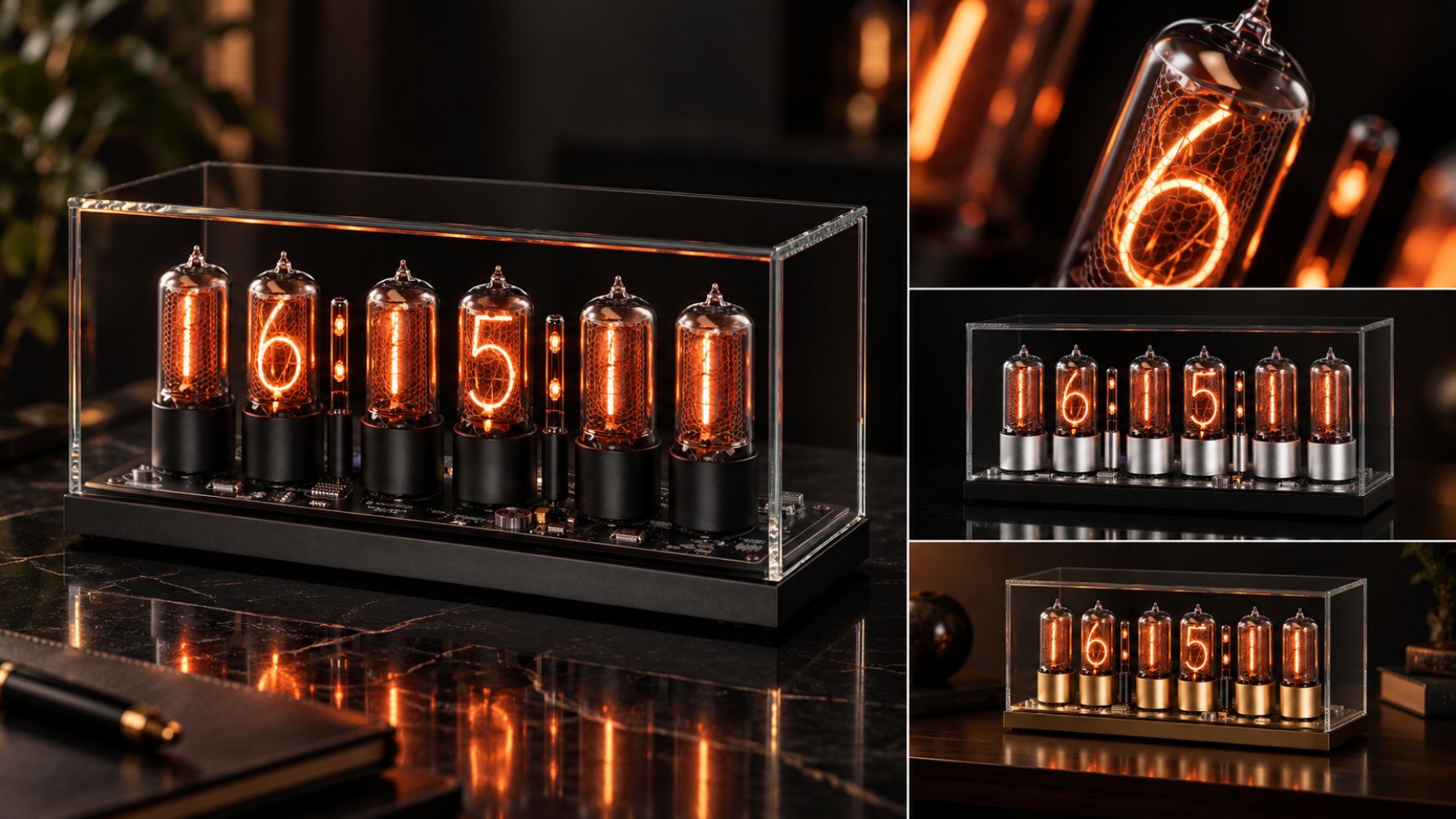
Searching for a real Nixie clock for sale sounds simple until you actually start looking.
At first, almost everything has the same orange glow. Some clocks use original Nixie tubes, some use newly made tubes, and others use LEDs hidden inside glass shapes that only look like Nixies. From a small product photo, the difference is not always obvious.
And if you are spending several hundred dollars—or more—it is worth knowing what you are actually buying.
Start with the tubes
The first question to ask is whether the clock uses real Nixie tubes.
In a genuine Nixie tube, the numbers are physical metal cathodes placed one behind another inside a glass envelope. When a digit is selected, the gas around that particular cathode glows orange.
It has depth. If you look at the tube from the side, you can actually see the different numbers sitting behind each other.
LED imitations can look attractive, but they are a different product. If the authentic glow is important to you, take a closer look at the construction before buying.
We covered the topic in more detail in our guide to real Nixie clocks vs. LED Nixie clocks.

Vintage tubes or modern tubes?
This is where things get more interesting.
Many Nixie clocks still use tubes manufactured decades ago. There is nothing wrong with that. In fact, vintage tubes are a big part of the appeal for many collectors.
The only difficulty is that their history can be hard to know. One tube may have spent 40 years untouched in storage, while another may already have thousands of operating hours behind it.
Modern Nixie tubes offer another option. They keep the same basic technology—glass, gas, and metal cathodes—but are made for clocks being built today.
For example, Millclock uses modern ZIN tubes in models such as the ZIN18 Nixie Clock and the larger ZIN70 Nixie Clock.
Neither approach is automatically better. Vintage tubes are fascinating pieces of history. Modern tubes are easier to build a consistent new product around.

Look beyond the glowing digits.
It is easy to focus entirely on the tubes, but a Nixie clock is also an electronic device that may sit on your desk for years.
Look at the rest of the clock.
Is the case made from real aluminum or wood, or lightweight plastic? Are the tubes properly aligned? Does the clock include brightness adjustment? Is there a night mode? What happens if a tube eventually needs replacement?
These details often separate a nice photograph from a clock that is genuinely pleasant to own.
A good finished clock should feel finished from every angle, not like a circuit board that happened to get a case around it.
Check how the tubes are driven.
You do not need to be an electronics engineer to buy a Nixie clock, but a few features are worth knowing about.
Proper current control matters because driving a tube too hard can shorten its life. Brightness control is useful not only for comfort but also because you rarely need maximum brightness in a dark room.
Another useful feature is an anti-poisoning routine. The clock periodically cycles through digits, illuminating even the less frequently displayed numbers from time to time.
If you are curious about tube life, our article on how long Nixie tubes last explains the subject in more detail.
Kit or finished clock?
You will also find plenty of Nixie clock kits for sale.
They can be great fun if soldering and electronics are part of the hobby for you. Building the clock is often half the experience.
But if what you really want is a beautiful clock for an office, living room or desk, a finished model is usually the simpler choice. It has already been assembled, tested and adjusted.
We compared both options in the Nixie Clock Kit or Finished Clock: Which Should You Choose?.
Support matters more than you might expect
A Nixie clock is not a disposable gadget.
Before buying, check whether the manufacturer offers spare tubes, repairs or technical support. If something happens several years later, being able to contact the company that actually built the clock is valuable.
Customer feedback can help here too. You can see experiences from Millclock owners on the reviews page.
So, where should you start?
If you want a compact handmade Nixie clock, ZIN18 is a practical place to start. If you want something larger and more dramatic, ZIN70 has much more visual presence.
You can also browse the complete Millclock Nixie clock collection.
The best Nixie clock is not necessarily the cheapest or the biggest. Buy the one whose tubes, electronics, materials and proportions you will still enjoy looking at years from now.


